Defying
the orders of his commander, the adventurer Hernando Cortez assembled his
army of Spaniards and some Indians in 1519, and sailed into a tiny fishing
village on the
east coast of what is now Mexico. He named the place Via Rica de la Vera Cruz
(Rich Village of the True Cross), and used it as the first base of the campaign
by which he eventually would conquer the Aztec empire and claim the territory
for Spain.
While Cortez battled the indigenous people and other Spanish soldiers on his way inland toward the ancient capital of Tenochtitlan--now Mexico City, that little coastal town began to grow. Over the centuries it became a center of the slave trade and attracted treasure hunters intent on plundering its rich deposits of gold and silver.
Today
Vera Cruz is a city of more than a half-million people and a major Mexican
seaport with an
important naval installation. And a tourist destination. We were glad when
we visited - for three weeks beginning Christmas Day in 2010 that nearly all
of the town’s visitors were Mexicans, perhaps the majority from Mexico
City. Families arrived during the kid's holiday break from school, eager to
frolic on the beach under sunny skies with temperatures about twenty Fahrenheit
degrees warmer than their hometowns. They filled the restaurants and shops
along the
malecon (seafront) and waited in line to visit La Acuario, one of the largest
and most popular aquariums in this part of the country. And what a treat for
Suzanne (my wife) and me to visit a popular tourist spot not over-run with people like us. I
think we saw one Anglo couple the whole time there. Only once did I hear someone
speaking in accent-free English.
We were immersed in a population of brown-skinned people and in the Spanish language. That’s exactly what was intended when we signed up at the Vera Cruz Spanish Language Immersion School where we stayed, took morning and noon meals, and heard only the language spoken by Cortez. The idea was to speak as well as listen, aided by tutoring sessions every morning, in hopes that we’d learn some rules of grammar and get a bit of practice in pronunciation.
That’s one of Suzanne’s travel secrets, by the way. Rather than sign up for a guided tour in an unknown place and putting up with their schedules and someone else’s itinerary, or going it alone and spending much of the vacation wondering how we got lost and what we’re missing, we enjoyed a bit of hand holding when we needed it and freedom when we didn’t. And we got the inside track on the places to go, things to see. Plus, if we wanted, the guides to get there.
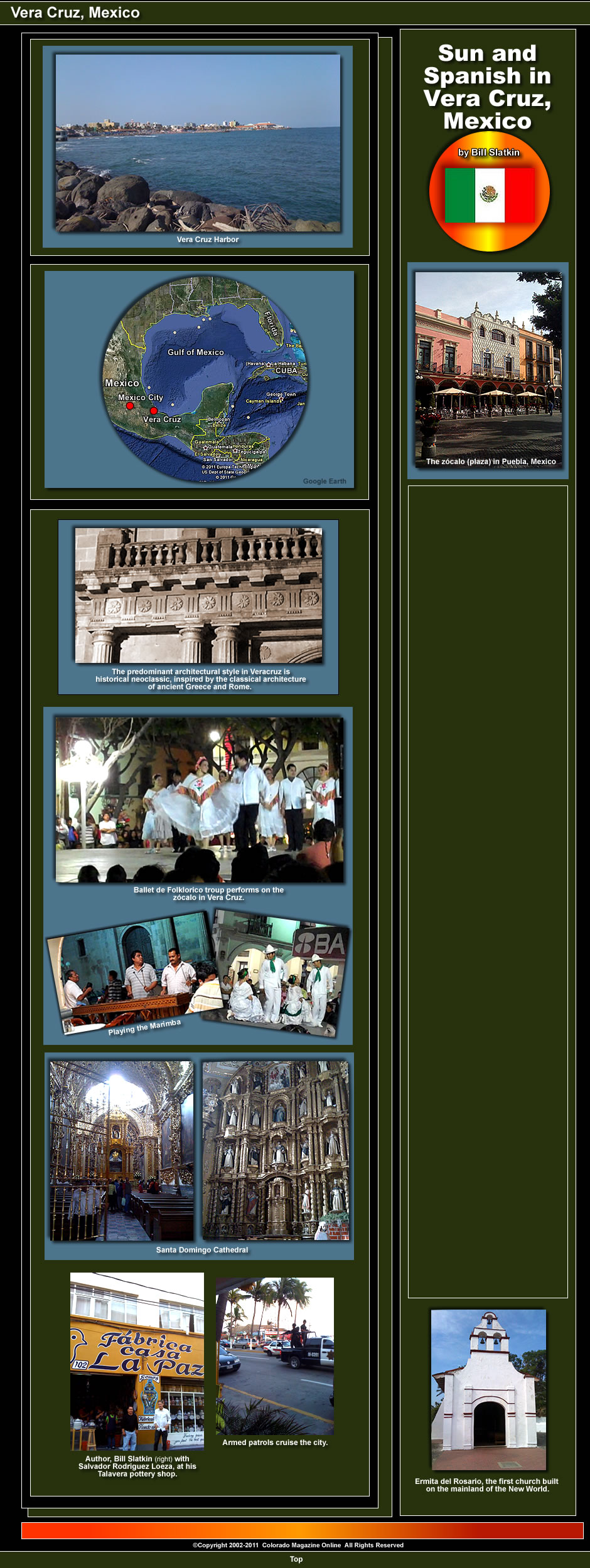
Among those places was Zempoala, about an hour bus ride from Vera Cruz, which boasts fascinating ancient ruins left by a native population all but killed off by Cortez and his men. Walking among the remains of pyramids built several centuries before the Spanish arrived, the visitor might be able to imagine the ceremonies held in this place. The people did not tread the land lightly. In their temples were virgin sacrifices to the gods. And in their athletic fields were contests of strength and ferocity ending with the victory of the combatant able to end the life of his opponent.
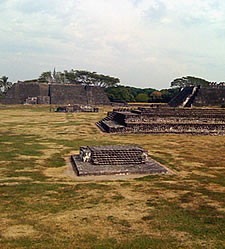
Though these grounds are no longer inhabited or cultivated, a ceremony kept alive is the ritual practiced by the voladores (from the verb “to fly”), with a special way to pray for water and healthy crops. We were lucky to see this spectacle performed by five men dressed in colorful native garb, continuing a tradition by the men in their families for generations into the past. It involves climbing to a platform atop a pole about 50 meters in height--an innovation after decades using tall trees - and then, as one calls for the attention of the appropriate deities with flute and drum, the others hurtle off the perch, heads down, swinging through the air suspended by ropes tethered to the top. They circle the pole, descending toward earth as their ropes unwind, and finally, safely, reach solid ground.
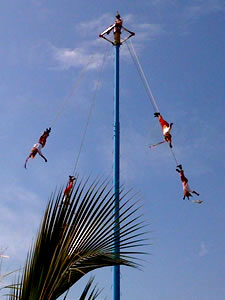
It was also on this excursion, organized by our school and led by Ana and Ada, two adorable and charming school staff, that we visited the village of La Antigua, site of Ermita del Rosario, the first church built on the mainland of the New World. Established here in 1523, this small chapel is a witness to nearly a half-millennia of history, with scratches in its aged wooden benches left by generations of worshipers, an image of Christ behind the alter - its colors muted by time, and a water mark along the length of one wall, about four feet from the floor, revealing the height of the flooding that accompanied Hurricane Karl which ravaged this area just months before our visit.
A short walk from the church brought us to Casa de Cortez. We stood inside its crumbling walls, trying to picture the forest that was cleared and used for construction of the conqueror’s home and offices. It was satisfying to notice the web of hardy vines growing along the remains of the structure as the trees go about reclaiming their site.
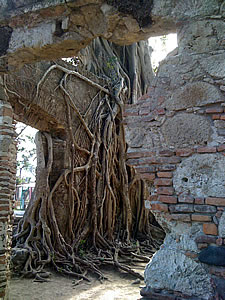
Casa de Cortez
Another outing had us dodging vines and tree limbs as our small lancha (motor boat) plowed through the manglades (mangroves) in the laguna (lake) at the La Mancha eco-tourist site. The way it had been described, we expected a pleasant and gentle cruise, a chance to relax and enjoy a bit of bird watching. It was more exciting than that. Most of the birds we saw were the buitres (vultures) circling above, moving closer each time the motor sputtered and died.
Enjoying Vera Cruz
Most every night of our visit was spent in the zocalo, the center square of Vera Cruz, strolling among the many displays of colorful clothing articles and jewelry offered by the locals, and trying out the restaurants around part of the center’s perimeter. One of the treats identified with this town is the lechero, a coffee with a bubbly topping of milk created by pouring the steaming leche from a pitcher held at least three feet over the cup.
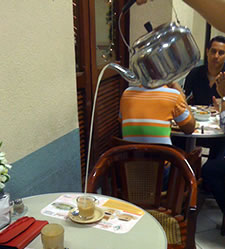
Making Lechero
The menu at the Grand Café, where this beverage is featured, includes
a number of fish and seafood items likely brought out of the Gulf just hours
before they’re served. The constant flow of vendors past our tables was almost annoying. So frequently
were we declining offers of blouses, belts, cigars, watches, sweets, carved
wooden items and other chatchkes that soon the word “no” was being
uttered even before the unwanted item was thrust in our faces.
And there was entertainment besides shooing away vendors. At least three little groups of musicians would fill the balmy evening air with the bell-like, vibrating tones from a marimba - an instrument associated with this part of Mexico. And we frequently caught a performance from one of the area’s excellent Ballet de Folklorico troups showing off their bright costumes and fancy steps.
For
variety, we visited the neighboring town of Boca Del Rio, curious because
it includes
a mix of structures and neighborhoods. First we encountered the row of tony
hotels - grand, modern buildings on lavishly landscaped grounds with exclusive access
to stretches of beach. Across the highway is the World Trade Center with state-of-the-art
meeting facilities and a large shopping mall. These contemporary structures
claim to be in Boca Del Rio, but it’s the original town, a bit farther
down the road, along a bank of the Jamapa River, that we wanted to visit. A home to fishermen for
generations this village has much more charm than the clusters of sleek edifices nearby.
Here we stopped to exchange a few simple words with the men who stood along
the water’s edge, tending to their nets and telling each other about
the big one that got away. Some waved menus at us, reminding tourists that it’s dinnertime, each pointing
to one or another of the many restaurants along the river’s edge. We
figured that whichever fellow got us into one of the eating places would receive some kind of commission, and since
we couldn’t accommodate everyone, we declined all invitations, promising
to be back later. Telling the white lie, incidentally, is as much a custom
in Mexico as shaking hands with a new acquaintance. Before we finally slunk
into a restaurant, hoping we wouldn’t be noticed
by those anticipating our business, we stopped off at Toritas, a tiny bar
that sells only its own creation. The La Chata brewed there is a creamy beverage
- think Harvey’s Bristol
Crème - containing about 15% alcohol and offered in coconut, mango
and other flavors. It’s easy to see how someone could continue to enjoy
one glass-full after another of this pleasant tasting elixir, then wonder
why it’s so hard to stand up and see straight.
Speaking Spanish
Our enjoyment of all this culture and cuisine came at a small price, of course. We had to ask for what we wanted and attempt to make simple conversation. I soon realized I was cultivating a false sense of confidence with the language, developed back at the school where the teachers and staff watched us and waited each time we tried to find the words to express ourselves, giving us reminders of key phrases as we struggled to convey an idea. Out in the real world people often pretended to understand what I was saying, probably to be polite. And if I did manage to string a few words together into an intelligible sentence, the response was a barrage of Spanish delivered far too quickly for me to follow.
At times I was proud of my ability to convey a basic idea to a merchant, waiter or bus driver. But so often I would begin to express a thought, then realize the vocabulary had abandoned me and I was stranded in mid-sentence without a clue about what to say. (This reminds me of swimming club when I was a youngster, managing with arm strokes and kicks to reach the middle of a lake, then losing breath and confidence, requiring help to get the rest of the way to shore.)
It was reassuring to learn that I wasn’t the only student who’d become so language challenged that even English was abandoning me. More than once, as I tried to conjure the Spanish word I wanted to use, I’d open the translation dictionary only to realize I couldn’t remember what the word is in English.
I guess I was starting to miss the sound of my native tongue. It certainly was a treat, at an expensive restaurant, to notice the food items were described in English as well as Spanish.
The
teachers said my Spanish was improving but I was unconvinced. I know there
were times when my attempts to use the language were quite amusing; my description
of a forest for example, using the word abuela (grandmother), instead of arbole
(tree). And there was the time I tried to order a chicken (pachuga) sandwich
without lettuce (lachuga). I continually and unknowingly gave contradictory instructions --“no,
I don't want lettuce, put lachuga in the sandwich, por favor!”- causing the
poor fellow behind the counter to become totally befuddled, much like the
straight man in the Abbot and Costello routine about ‘who’s on
first.’
The Miracle of the Boletas
Despite
my occasional role as ugly American, I did manage to learn some Spanish words
and figure out how to use them. This wasn’t the only attempt I’ve
made, over the years, to gain some familiarity with the language in a Spanish
education program. But it was the
best. The setting had that appealing laid-back Mexican vibe without compromising
the feeling that we were in reliable hands throughout our visit.
It’s where I learned about the unwritten law I call the “Mexican Way,” meant to remind visitors not to get too stressed when things don’t go as planned. This law dictates that problems somehow seem to resolve themselves in Mexico.
I
found out about this from Eric Langner, an American expat who, along with
his wife Linda, owns and runs the school. The lesson came on a most frustrating
day when the bus tickets we’d purchased for a weekend trip to Puebla disappeared.
In the cab, on the way to the bus depot, Suzanne checked with me to make sure I had the boletas
(tickets) for the bus. Oops! That was the first time the cab driver was told
to turn around and go back to the school. As it turned out, those boletas could not be found
in the place where I was ABSOLUTELY SURE I had put them, I recommended we
go to the station anyway -- time was getting short, the bus would soon leave - and attempt to
explain the problem in hopes we’d be allowed to take our reserved seats.
After reflecting on my skills at explaining myself in Spanish, Suzanne nixed
the idea and so the cabbie was again
instructed to return to the school.
A third trip was aborted after my next brain-storm (just get a new set of tickets), and Suzanne’s quick calculation of our budget, followed by another “back to the school instruction.
Then
there was the argument with the cab operator who felt entitled to an extra
fee as penalty for making him drive in circles (and for being stupid Gringos
who can’t agree on
what they’re doing).
Back in the school, I was feeling funky and blue, picturing the bus leaving for the place we wanted to visit, calculating the money wasted on lost tickets and possibly a penalty from the hotel for a cancelled reservation.
“What’s up?” Eric wanted to know.
So
I summarized the dilemma, including the fact that the tickets had disappeared.
Then Suzanne contributed her side commentary, explaining that since I was
ABSOLUTELY SURE of where I’d put those tickets, the “disappearance”
must be a miracle--the miracle
of the boletas.
That’s
when Eric advised us to relax, and explained about the Mexican Way. I was
unconvinced…until, that is, Jorge (perhaps my favorite of the teachers)
got on the phone
with the bus company, while Ada (another of our beloved maestros) hailed another
cab and accompanied us to the bus station so she could intervene on our behalf.
The ‘miracle of the boletas’ tale ends on a happy note. The bus, running a bit behind schedule, was still at the station. Our reservations were quickly confirmed and we were escorted to our seats with wishes for a comfortable trip. (It was the next day when thumbing through a notebook in which I was ABSOLUTELY SURE I had not placed the boletas, that they appeared. They’d been with us all along. What a miracle!)
And upon our return, I had to acknowledge to Eric the accuracy of his prediction that things would find a way to work out satisfactorily.
The
appeal of Puebla, incidentally, has to do with its many beautiful churches,
including Santo Domingo with its incredible wall of statuary and gold inlaid
chapel ceiling, and
Catedral de Puebla, with its massive towers rivaling any church in Mexico
for size and grandeur. Then there is the zocalo de Puebla, the most lush of
any town center we’ve
seen in visits to probably a dozen zocalos in Mexico. It is in this town that
the art of Talavera--originated in the Talavera region of Spain in the Sixteenth
Century - is on display in several ceramic workshops that produce the colorful pieces - such
as tableware, and wall hangings - and in gorgeous tiles that dress many of Puebla’s
government and commercial buildings. Ceramic workshops in other parts of the world may call
their product Talavera. But don’t be fooled. It’s only the real
deal if produced in the Mexican city of Puebla.
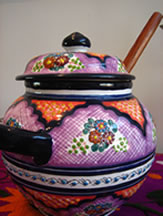
Talavera Tureen
Adding
a couple of Talavera vessels - created by Salvador Rodriguez Loeza, whom we
met at his shop - to our cherished collection of travel mementoes, was an
experience both joyful and nerve wracking. The fun aspect is the way these
elegant pieces dress up our dinner table. The worrisome part was whether we
could get them home in one piece. (The successful transport strategy, incidentally,
involved wrapping each item with several
layers of newspapers sealed with plastic tape, then placing them in our carry-on
bags surrounded and cushioned by our dirty laundry. While the people at customs
wanted to inspect the contents of the satchels, they didn’t spend much
time poking their gloved hands inside, and never asked us to take the pottery
out of its wrappings.)
Asta la Vista Vera Cruz
While
Vera Cruz doesn’t rank among the most popular tourist destinations in
Mexico, it’s
definitely a place worth a visit, at least during the winter when the weather
is pleasant, to find out what changes were made since Cortez was here. I consider
it a plus that this place doesn’t attract many Californian’s,
Texans or Coloradoans as do the Mexican
towns that get most of the publicity. My dad used to say that “if you
go to a foreign country, expect to see lots of foreigners.” We were
the foreigners here, and happy about that.
And while three weeks in Mexico is always a long enough visit for me, as I start to miss my quaint little habits, such as using tap water rather than the bottled kind to rinse my toothbrush, I must admit I almost shed a tear when we pulled away from the school. This place kind of felt like a home…a home with people we’d come to enjoy - sweet and intelligent folks with whom we’d shared laughter, several meals and some aspects - obvious as well as obscure - of the Spanish language.
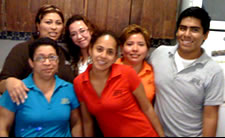
Teachers
and staff at the language immersion school.