
By
Bill Slatkin
one
way to appreciate Venice is to
know a bit about its history.
And it’s not necessary to go back to the Veneti people who occupied
a few of the 117 islands clustered in a northern corner of the Adriatic
Sea, fishing in its waters, during the time of the European Iron Age.
Its location along a vital East-West trade route enabled Venice to profit
from its busy seaport and strategic land location, and gain influence
in the area, first as part of the Roman Empire then under the control
of Byzantine leadership.
The most prosperous city in Europe for much of the middle Ages, Venice
also was known as an important center of art, not only the paintings,
sculpture, fabrics and other treasures brought from distant places and
cultures, but also a home-grown artistic tradition with important painters
and architects and a glassmaking industry.
For much of the Fourteenth and Fifteenth Centuries Venetian glass was
more plentiful and more delicately beautiful than glass made anywhere
else in the world. We visited the island of Morano, a half-hour water
taxi ride from the Venetian island, where, in the Thirteenth Century,
the Venetian government sent the city’s glass working artisans
to practice their craft. The idea was to move the risk of a destructive
fire off the Venetian island.
Hoping we would buy some of their product – which we did—operators
at one of Morano’s many glass making factories ushered us into
a smoky hot building to watch these incredible artists bring bright
yellow balls of molten glass from the furnaces, then use their iron
tools to coax wonderful shapes out of the hot masses.
Another Island, Burano, is known for the work of women there who, centuries
ago, began creating delicate needlework, primarily lace of many colors
and styles, used in clothing, kitchen and bedroom linen, and elegant
wall hangings.
In between the visits to the shops in brightly colored little buildings
along the main road of Burano, I enjoyed the best risotto I’ve
ever tasted. The Trattoria da Romano is known for its risotto and for
a number of other items on the menu which are nearly as renowned as
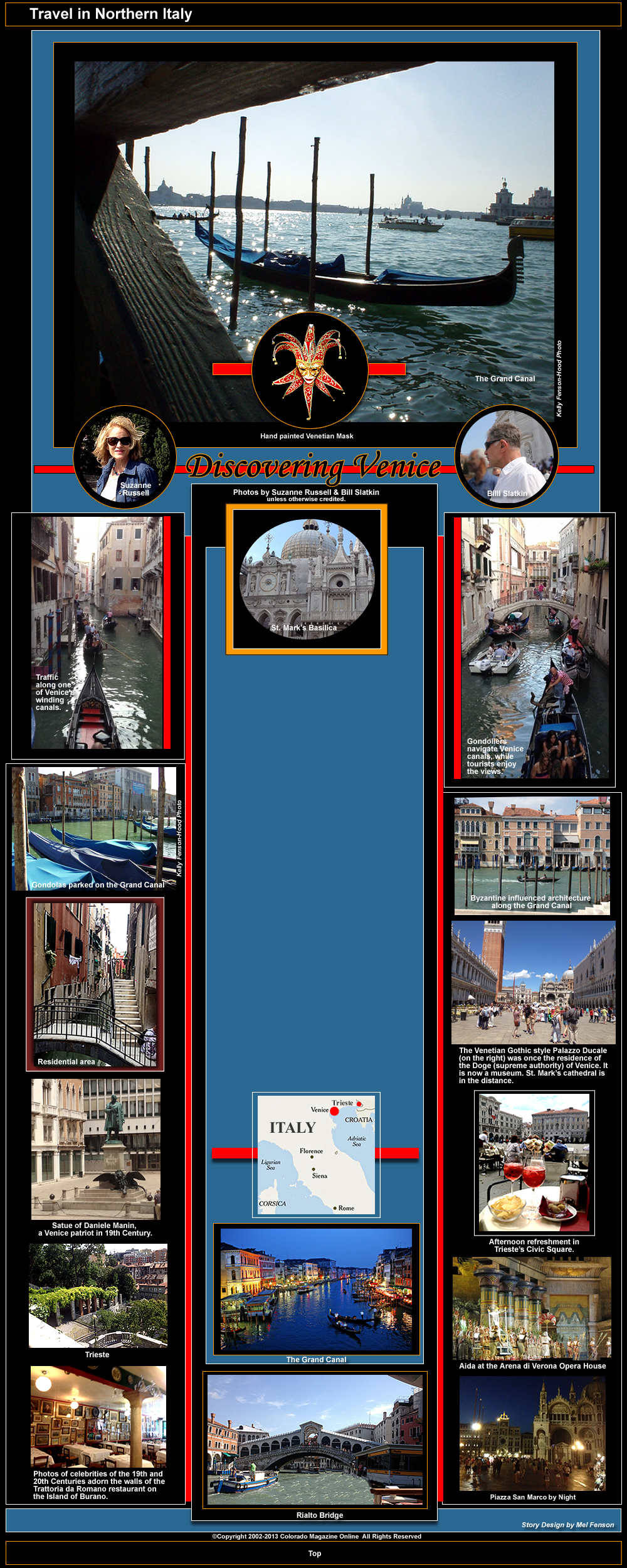
its walls of photos showing artwork and pictures of visiting celebrities
from the worlds of art, literature, entertainment and politics.
That’s the only food establishment to be mentioned, incidentally.
I fail badly as a restaurant reviewer, as I don’t have the background
or palate to comment intelligently on where I’ve been or what
I’ve eaten.
Redentore
The Venetians took responsibility for their own defense, fighting off
invaders, withstanding the attack of Charlemagne, and building Europe’s
most powerful navy, thanks to the practice of arming merchant ships
and pressing them into military service when needed. Venice was an independent
city-state by the Thirteenth Century and used its wealth to expand its
power. Venetians helped to fund the Fourth Crusade in 1204, which hastened
the decline of the Byzantine Empire with the sacking of Constantinople.
Much of the plunder taken from that once great city is on display in
today’s Venice.
The bad news was that Venice’s military power was challenged during
a long war with the Ottoman forces in the Fifteenth Century and then
Venetians were struck by the plague, which took 50,000 lives—nearly
a third of the population--in the Sixteenth Century.
We were fortunate to be in Venice in Mid-July during the annual celebration
of Redentore, commemorating the end of the “Black Death.”
A highlight of this festival is a visit to Chiesa del Santissimo Redentore
(Il Redentore) completed in 1592 on Giudecca Island to give thanks to
the Redeemer for saving most of the Venetians from the disease. To visit
this small and stately church we crossed the quarter-mile–wide
canal to Giudecca on a pontoon bridge, erected for use a single day
each year as part of the celebration.
Walking on that bridge, as it swayed and bobbed in the wind, was our
little party of four--my wife and me and two friends--along with thousands
of Venetians and tourists visiting from various places across the world
who had planned to participate in, or merely stumbled into—as
we did—this Venetian celebration. From a small (and permanent)
bridge a few meters from the steps of Il Redentore we watched the gondola
races that are part of the Redentore activities. Perhaps Italians familiar
with the competition among two-man crews in brightly colored uniforms
that match the yellow, red, green, lilac or other hue of their boats,
can figure out who won. For us, observing the gondolas crisscrossing
in front of us, and going in every direction of the compass, it seemed
more a spectacle than an orderly sporting event. It’s possible
some of the fans weren’t sure for whom they cheered. Partying
the night before included dining, dancing and drinking on dozens of
boats along the northern shore of the canal, followed by one of the
longest, most spectacular fireworks displays I’ve ever witnessed.
From there, many of the celebrants motored or rowed over to the Lido,
an island appreciated for its beaches, so they could enjoy a night cap
or two, and watch the sun rise over the Venetian Lagoon.
Piazza San Marco
It also was toward the end of the Sixteenth Century that the Doge’s
Palace, an enormous cluster of buildings on the edge of Piazza San Marco
(San Marco Square), was expanded and repaired after one of many fires
that damaged what had grown into a combination government center, living
quarters, court house, armory, art museum and prison. It was first built
in the 1100s to serve as the apartment and offices for a succession
of doges, who were elected to serve as chief magistrates for the city.
In all, more than 100 doges served in the period from 697 when Paolo
Lucio Anafesto was placed into the office, until the end of the Eighteenth
Century, when Napoleon’s forces claimed the city for France and
dispensed with the doges system of government.
Tourists gather on the Ponte dei Sospiri, the Bridge of Sighs, to stare
at the passageway that connected the palace to the prison, and to imagine
how it must have felt for those convicted of crimes to walk through
that passage into lifelong confinement. Glancing through the opening
sculpted into the wall of the passageway, the prisoners got their very
last glimpse of the outside world and maybe spotted a loved one throwing
goodbye kisses from the Sospiri Bridge.
The palace adjoins St. Marks’s basilica a large, five-domed Byzantine
style cathedral that was created with its early construction in 1063
and then expanded and decorated with gold and art treasures found locally
or brought from distant places. Together the cathedral and the palace
occupy much of the eastern edge of the Piazza, a public space probably
large enough to accommodate the football fields of half the teams in
the NFL. On each of our several visits to the Piazza, whether during
daylight or at night, we saw hoards of tourists, travel groups of students,
various clubs and organizations, and the hundreds--perhaps thousands--who’d
just disembarked from one of the cruise ships that motor up to the deep
water dock, turn the passengers loose into the Venetian streets for
a few hours of exploration with cameras and credit cards, then raise
anchor before moving along to a brief, photo worthy, visit at some other
romantic European city.
We visited the square often because it is a hub with several walkways
radiating into other districts of the City. Besides, San Marco Square
was just one vaporetto (water taxi) stop away from the dock close to
where we made our home for the two-week stay in Italy. The one bedroom
apartment, by the way, was arranged for us through an Internet home-exchange
site that had us trading residences with a Venetian family. It’s
fortunate that ours wasn’t a simultaneous exchange--that our hosts
were in Venice at the same time we were, not only because we had a chance
to sit in one of the lively squares over coffee with them, but also
because the dad of that lovely family saved my skin. More about that
later.
Austrian Influence
Once in command, by the way, Napoleon turned Venice over to the Austrian
Empire to rule, took it back in 1805, then lost it ten years later when
the Napoleonic Wars ended with the general’s defeat at Waterloo.
With some exceptions, the solid edifices standing proudly along the
Venetian Grand Canal, and in some of the walkways that twist through
the City--from one beautiful, busy piazza to the next, exude a subtle
grandeur in their graceful lines and shaped stones. It wasn’t
until we took a day trip by train to Trieste, further east on the northern
coast of the Adriatic toward Croatia, that the Austrian connection with
this part of Italy was apparent. The boldly rectangular buildings circling
the city’s government square, and the Teatro Verdi, Trieste’s
opera house named for the great Italian composer and designed by German
architect Matteo Pettsch, were structures defined by the straight unforgiving
lines and forceful presence strongly suggesting buildings that a visitor
will see along the grand boulevards in Vienna and in Germany’s
metropolitan areas. It was that style of architecture, and the presence
of the beer halls that reveal some of Trieste’s roots before it
was reclaimed by Italy after WWI.
Another day trip--a long day at that--involved a Verdi opera at the
Arena di Verona, a two-hour drive west of Venice, to enjoy Verdi’s
monumental work, Aida. The calm night was filled with the stirring musical
theme framing the show-stopping victory parade of gold-braid festooned
officers mounted on white stallions, announced by a company of buglers,
and followed by an army of soldiers, then the commoner hoards cheering
the Egyptian forces that had successfully repelled the attacking Ethiopian
army. The story ends in tragedy, of course--the death of main characters.
It all was played out in this setting, surrounded by the steeply descending
stone stair-seats, where two millennia in the past, tens of thousands
of spectators witnessed real blood shed in the battles of Roman Gladiators,
and maybe the one-sided contests between hungry lions and unfortunate
Christian slaves.
My reluctance to talk about the restaurants shouldn’t suggest
that I didn’t eat well. I don’t remember a bad meal, whether
fish, poultry, beef, or the many versions of pasta, not to mention all
of the pizzas that I enjoyed in various establishments, formal and casual--medium
priced to expensive--in Campo S. Toma, Campo San Giacomo, Campo S. Barnaba,
Piazza San Marco and along the calles that make up the maze of street
systems on the island. The most memorable meal was in a tiny kosher
restaurant on a Friday night in the Jewish Ghetto. We hadn’t planned
it, in fact, we’d already had dinner, and were walking through
the neighborhood when a bearded man in black stopped me on the street
to ask: “Are you Jewish?” (“Funny, you don’t
look very Jewish,” says the shicksa I married). With her urging,
we accepted his invitation into the crowded place, people sitting at
long tables, elbow to elbow, passing the chicken soup, platters of chicken,
beef, potatoes and vegetables. And basket after basket of challah bread.
We tasted each dish and exchanged greetings with people from Germany,
France other parts of Italy--even with other Americans. Meanwhile, the
fellow who invited us stood with other dark garbed men, at the end of
one of the tables, leading us--with their arms locked in brotherhood--in
singing songs with which Jews have ushered in the Sabbath for a hundred
generations. I certainly hadn’t traveled all the way to Italy
to partake in this food--it’s been familiar to me since the days
when I ate at Grandma’s table. But being in this crowded, noisy
place with my wife, because a local community had opened the flaps of
its tent and welcomed strangers to enjoy its hospitality, and celebrate
the week’s day of rest, made it the meal to remember.
As little as I know about food, I can speak even less knowledgeably
about art, except to mention that it was thrilling to walk through the
rooms at the Peggy Guggenheim Museum, marvel at the work on the walls--some
of the cubist, abstractionist, expressionist and surrealistic art I
could appreciate, other pieces left me scratching my head--and learn
about Peggy’s history as patron/lover to some of the most revered
artists of the early 20th Century.
Equally fascinating and somewhat mystifying to me are the works on display
at the Gallerie dell’ Accademia, representing work of artists
from the Byzantine and Gothic Fourteenth Century to the Bellinis’
Carpaccios, Veroneses and other painters and sculptors of the Renaissance
up until more recent history--the Eighteenth and Nineteenth Centuries.
We brought home printed materials from the museums and historical places
we’d visited, a few of the beautiful pieces we discovered that
‘we could not live without’ during visits to Morano and
Burano, a CD of Interpreti Veneziani, the string ensemble whose performance
we enjoyed in a chapel on a balmy Venetian night, and numerous other
relics and souvenirs that were gifts for friends and relatives or items
for us to cherish and place proudly in our home.
What’s most important, I think, is the memories of walking along
the waterways, crossing them on the picturesque bridges, getting lost
in the impossible crisscross of broad and tiny paths that link the many
parts of the island and contribute to its unique character. It’s
hard to imagine a place with no cars, no traffic, no noisy and smog
filled roadways. The sounds you hear are the church bells ringing throughout
the city to alert residents and visitors that services are about to
begin. Even having been there it’s hard for me to believe Venice
exists. But it’s there, in my memory, on the map, in the history
of Europe that goes farther back than Year One, AD.
Seeing posters showing an elegantly dressed couple enjoying their
after dinner drink in San Marco Square, their legs submerged in lagoon
water, causes me concern about the future of this city. Its buildings
sit on footings connected to pilings that have supported Venice for
hundreds of years. But from what I’ve been able to learn, and
contrary to some opinions, it’s not that the city’s under-footing
is failing, causing the lagoon to rise, and Venice to sink. There is
evidence the sinking began with the practice of drilling artesian wells
around the island, which is dropping as removal of water causes the
aquifer to contract. Since a law was instituted some years ago, prohibiting
further extraction of water in this manner, the sinking has slowed.
And there’s hope that Venice will not suffer the fate of Atlantis
and disappear altogether. A number of engineers are working with a system
of inflatable pontoons which they believe will protect the city from
flooding during high tides.
Meanwhile,
the engineers, the Venetians, and visitors who love the beautiful, mysterious
city understand that changing world climate threatens to overwhelm even
the most innovative efforts to hold back the sea. Recent flooding in
the city is a reminder that this island and its lyrical way of life
may one day be reclaimed by the Adriatic.
Saved by the hero
Among my memories of Venice is my idea of an Italian hero--the man whose
family owns the place where we stayed.
After several wifely reminders to keep track of my passport, and after
I closed the door of our temporary residence at 5:15 am for the last
time, tossing the key through the mail slot and beginning our run to
the water taxi for the early morning trip to the airport, I patted my
pockets, taking kind of an unconscious inventory, and became suddenly
very conscious of what I was missing.
Passport in house. Door locked. No key and in a hurry to get to the
first of the two boats that would make sure we were on time for our
flight home.
I envisioned the grilling I’d get in the back room of the flight
security department at Marco Polo Airport. And the hours, maybe days
of waiting until I could get the necessary documents, then a flight
back to the States and rejoin my wife who would have been home for a
few days by then. I didn’t think about what it would cost. I didn’t
want to think about that. Nor did I want to think about the fact that
I was down to about six Euros and that the Italian banks weren’t
honoring my debit card.
One possible chance to solve this awful drama—a slim chance. If
our host could somehow interrupt his sleep and his morning schedule,
take the vaporetto to the house, find the passport, vaporetto back to
where his car was parked, drive to the airport….
Though traumatic, the end of our trip was completed without incident,
and we traveled home together as planned. My wife graciously said nothing
about my forgetfulness and I kept touching my pocket to make sure the
newly recovered passport was still with me.
The sun was high in the Italian sky when I peered out of the Lufthansa
craft’s window to the cluster of islands seeming to float atop
the blue-green Asiatic and looking as magical from the air as it did
when we were there.